




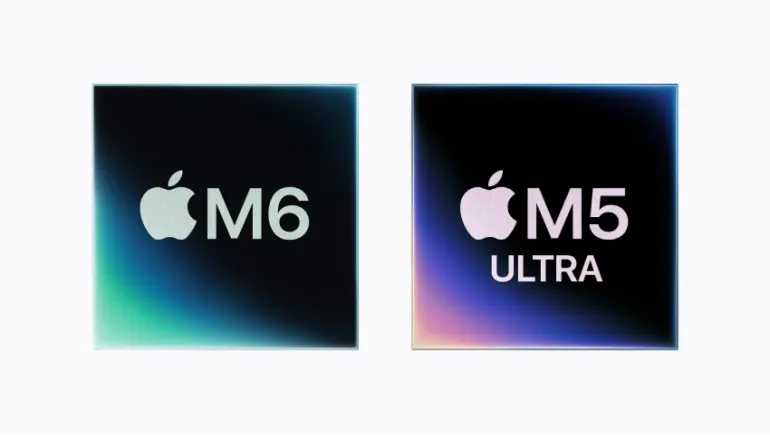
Apple launched two very different chips on the same day. M6 brings Apple's first 2nm process to the Mac mini. M5 Ultra brings a first-ever quad-die design to the Mac Studio. Here's which one actually matters for you.
Apple rarely announces two new chips at once, but that's exactly what happened in August 2026. Apple M6 debuted inside the new Mac mini, becoming Apple's first chip built on a 2-nanometer process. On the same day, M5 Ultra arrived inside the new Mac Studio, using a quad-die design that combines four chips into one, Apple's most powerful M-series chip to date.
These two chips aren't really competing with each other. They sit at opposite ends of Apple's lineup, built for different budgets and different kinds of work. This guide breaks down what each chip actually offers, so you can figure out which one, if either, is right for you.
M6 vs M5 Ultra: Quick Comparison
- CPU: M6 has up to 12 cores; M5 Ultra has up to 36 cores
- GPU: M6 has 12 cores; M5 Ultra has up to 80 cores
- Neural Engine: Both use a Dual 16-core Neural Engine, but M5 Ultra pairs it with far more GPU-side AI hardware
- Unified memory: M6 supports up to 32GB; M5 Ultra supports up to 512GB
- Memory bandwidth: M6 reaches 170GB/s; M5 Ultra reaches 1.2TB/s
- Manufacturing process: M6 uses Apple's first 2nm process; M5 Ultra uses the older 3nm process across four connected dies
- Where you'll find it: M6 powers the Mac mini, starting at $899; M5 Ultra powers the Mac Studio, starting at $5,499
M6 vs M5 Ultra: What Actually Changed?
M6 is a generational step forward from the standard M5 chip, not a replacement for Apple's higher-end silicon. Apple has confirmed there will be no M6 Pro, M6 Max, or M6 Ultra variants this cycle, choosing instead to focus development on the next AI-optimized generation. That means M6 exists on its own, as Apple's first chip built on a 2-nanometer process and the first Apple silicon design to use three different CPU core types in one chip.
M5 Ultra, on the other hand, is built by fusing two M5 Max dies together using Apple's UltraFusion technology, and for the first time, doing that across four total dies rather than two. Apple says this quad-die approach delivers over 4.4TB/s of interconnect bandwidth between the dies, letting all four behave as one unified processor rather than four separate chips working together.
CPU Performance
M6 uses a 12-core CPU complex that Apple describes as containing the world's fastest CPU core, delivering up to 1.2x faster multithreaded performance than the standard M5 chip. For everyday tasks like web browsing, document editing, and general multitasking, this difference is unlikely to be something you notice directly, since the M5 already handles those tasks comfortably.
M5 Ultra scales far beyond that, with a CPU configuration reaching up to 36 cores. Apple rates it at up to 1.25x faster single-threaded performance and 1.3x faster multithreaded performance compared to the previous M3 Ultra. For workloads that lean on many CPU cores at once, like compiling large codebases or running simulations, M5 Ultra's core count advantage becomes the deciding factor.
GPU and Graphics Performance
M6 ships with a 12-core GPU, two more cores than the standard M5, with a Neural Accelerator built into each core. Apple says this delivers roughly 30% higher peak GPU compute for AI tasks compared to M5, along with a 50% increase in geometry rates for complex graphics and hardware-accelerated ray tracing.
M5 Ultra's GPU scales up to 80 cores, also with a Neural Accelerator in every core. Apple reports up to 40% faster graphics performance compared to the M3 Ultra it replaces. For 3D rendering, complex visual effects, or GPU-accelerated simulations, this is where M5 Ultra separates itself most clearly from anything in the standard M6 lineup.
AI and Neural Engine
Both chips use the same Dual 16-core Neural Engine, which handles dedicated on-device AI tasks. Apple says M6 delivers up to 2x higher peak Neural Engine compute compared to M5. M6 also introduces native hardware support for FP8, an 8-bit numerical format designed to speed up AI workloads and reduce memory use, a task the standard M5 has to handle through software instead.
M5 Ultra's AI advantage comes less from the Neural Engine itself and more from its much larger GPU and unified memory pool working alongside it. Apple reports up to 4.3x higher peak AI compute for M5 Ultra compared to the M3 Ultra, driven largely by having far more Neural Accelerator-equipped GPU cores available to share the workload.
Memory and Bandwidth
This is one of the widest gaps between the two chips. M6 supports up to 32GB of unified memory with up to 170GB/s of bandwidth, about 10% higher bandwidth than the standard M5. M5 Ultra supports up to 512GB of unified memory, reaching 1.2TB/s of bandwidth, roughly seven times more memory and seven times more bandwidth than M6's ceiling.
For most everyday and creative tasks, M6's memory ceiling is more than enough. But for running large local AI models, M5 Ultra's memory pool matters directly, since bigger models simply won't fit, or won't run efficiently, inside M6's more limited memory space.
Power Efficiency
M6's 2-nanometer process is built specifically for efficiency, packing more transistors into a smaller space while using less power per task. Apple positions the Mac mini with M6 as a compact, low-power machine that still delivers more performance than its predecessor meaningfully.
M5 Ultra, despite combining four dies, still uses Apple's more established 3-nanometer process rather than M6's newer 2nm node. Apple prioritizes raw compute over efficiency here, since the Mac Studio is designed to sit on a desk connected to power, not to preserve battery life. In other words, M6 is the more power-efficient chip by design, but M5 Ultra is not trying to compete on that metric.
Video Editing and 3D Rendering
M5 Ultra includes a significantly more advanced Media Engine than M6, with dedicated hardware for H.264 and HEVC, four ProRes encode and decode engines, and hardware-accelerated AV1 decoding. Apple says the Mac Studio with M5 Ultra can decode up to 33 streams of 8K ProRes 422 footage at once and drive up to eight displays simultaneously. That level of dedicated media hardware matters directly to video editors working with multiple high-resolution streams, since it offloads work from the CPU and GPU entirely.
M6 can absolutely handle video editing and 3D work, especially for individual creators or smaller projects, but it isn't built for the same scale of simultaneous, high-resolution workloads that M5 Ultra targets.
Which Chip Is Better for AI?
The honest answer depends on what kind of AI work you're doing. If you're running smaller local AI models, using on-device features, or working with lightweight machine learning tools, M6's native FP8 support and doubled Neural Engine compute make it a genuinely capable chip for the price. If you're training or running large language models locally, M5 Ultra's massive unified memory pool is the deciding factor, since it's the only chip in this comparison that can hold very large models entirely in memory without splitting work across multiple machines.
M6 vs M5 Ultra for Everyday Users
For most everyday users, buying a Mac for browsing, office work, streaming, and light creative projects, M6 is the more sensible chip by a wide margin. It's dramatically cheaper, more power-efficient, and already delivers more performance than the vast majority of daily tasks require. There's little practical reason for a general-purpose user to consider M5 Ultra at all.
M6 vs M5 Ultra for Professionals
For professionals doing 3D rendering, scientific computing, large-scale video production, or local AI model training, M5 Ultra is built specifically for that workload. Its CPU core count, GPU core count, and memory bandwidth all exist to serve demanding, sustained, multi-threaded work. Professionals whose tasks don't push that hard, like photographers, podcast editors, or app developers working on smaller projects, may find that an M5 Pro or M5 Max configuration offers a better balance of cost and capability than jumping straight to M5 Ultra.
M6 vs M5 Ultra: Which One Should You Choose?
Choose M6 if you want a fast, efficient, affordable Mac for everyday computing, light creative work, or running smaller AI models on-device. Choose M5 Ultra only if your work genuinely requires its scale, heavy 3D rendering, professional video pipelines, scientific computing, or running large AI models locally without relying on the cloud. For the vast majority of buyers, M6 delivers more than enough performance at a fraction of the cost, while M5 Ultra exists for a smaller group of professionals who already know they need it.
M6 and M5 Ultra Price in Bangladesh
Apple does not sell directly in Bangladesh, so official local pricing isn't published. Based on confirmed US pricing, the Mac mini with M6 starts at $899, and the Mac Studio with M5 Ultra starts at $5,499. Prices from authorized resellers and importers in Bangladesh will typically run higher than these US figures once duties, taxes, and shipping are factored in, so it's worth checking with a local authorized Apple reseller for an accurate quote before buying.
FAQ
Is M6 faster than M5 Ultra?
No. M5 Ultra outperforms M6 in nearly every raw performance category, including CPU cores, GPU cores, and memory bandwidth. M6 is a smaller, more efficient chip built for a much lower price point, not a competitor to M5 Ultra's scale.
Is M5 Ultra overkill for normal use?
Yes, for most people. M5 Ultra is built for demanding professional and AI workloads. Everyday tasks like browsing, office work, and streaming run comfortably on far less powerful chips, including M6.
Will there be an M6 Pro, M6 Max, or M6 Ultra?
Apple has said it does not plan to release M6 Pro, M6 Max, or M6 Ultra chips this cycle, choosing to move development resources toward its next AI-focused chip generation instead.












Comments
There are no comments for this Article.