


01 November 2026
|
8:10:45
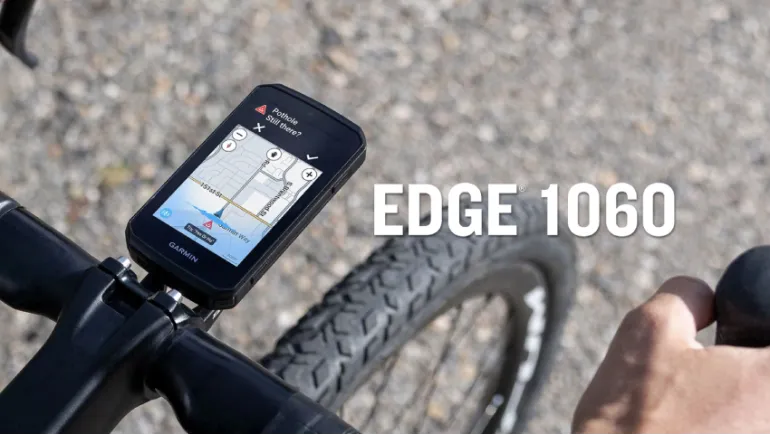
Garmin's new flagship listens for "Okay, Garmin," so riders can change screens, pick routes, and report hazards without leaving the handlebars.
Garmin announced the Edge 1060 on October 20, 2026. It replaces the Edge 1050 as Garmin's top cycling computer, and it adds the first microphone ever built into an Edge. That microphone enables hands-free voice control, which is the headline feature.
This blog covers what's new, how voice control works, how the Edge 1060 compares with the Edge 1050, and whether it's worth buying.
Riders say "Okay, Garmin" and then speak a command. Garmin's examples include "Report a pothole," "Route me to the closest coffee shop," and "What is my heart rate?" The Edge responds by changing the screen, reading out ride stats, or suggesting routes. Basic commands run on the device, while messaging and hazard reports need a paired phone.
Garmin lists some limits. Voice commands work only in select languages, performance varies with riding conditions, and some navigation commands may be limited in certain regions. Nobody has yet tested how well it hears you at speed or in traffic.
With the Garmin Messenger app and a connected smartphone, riders can send voice messages from the Edge. Incoming messages play aloud through the built-in speaker. The speaker also reads navigation and workout prompts, and it plays a digital bike bell so others hear you coming.
Riders can report potholes, obstructions, and other hazards by voice. Other Garmin cyclists then see those reports. This requires a compatible smartphone and the Garmin Connect app.
Route Options shows several ways to reach a destination. Riders can choose by ride time, elevation, and bike type. Route Previews then show distance, estimated ride time, traffic, and reported hazards before the ride starts.
Up Ahead lets riders pick the stops that matter most, such as coffee shops, restrooms, or gas stations. The Edge then shows the nearest ones along the route.
New road closure alerts come from reports by other Garmin cyclists. Free Flow Routing finds routes with the fewest stops, intersections, and slowdowns, which helps riders hold their speed during training. The Edge also supports bike-specific maps, popularity routing, and course syncing with apps such as Strava, Komoot, and Ride with GPS.
The training tools come from the Garmin Human Performance Lab. They include real-time stamina, a power guide with recommended targets, cycling ability, and course demands analysis. Some of these features need a compatible heart rate monitor, power meter, or both.
Riders can also create a free Garmin Cycling Coach plan that adapts to performance and recovery. TrainingPeaks workouts sync automatically. With a compatible Garmin watch or CIRQA Smart Band, the Edge shows recovery and health stats. GroupRide detection adds in-ride messaging, live locations, and incident alerts. The workout screen is now interactive, and riders can customize the home screen.
For mountain bikers, the Edge supports MTB Dynamics, Grit and Flow metrics, 5Hz GPS recording, and trail maps with Trailforks data.
Reverse charging works with a USB-C cable, but Garmin says it isn't meant for charging while riding.
The 1050 can't get voice control through an update because it lacks a microphone. Reports say some other new software features will reach it.
Garmin lists the Edge 1060 at $799.99 in the US and says it's available now. Pricing is £699.99 in the UK and €799.99 in Europe, and Australian pricing is A$1,299, with stock due in mid-November. Garmin's Singapore page still says "Coming Soon," so availability varies by region.
Buy it if you're getting your first premium Garmin and you'll use voice control, messaging, or the new routing tools. Choose the Edge 1050 if voice doesn't matter, since it shares the same screen, battery rating, and training features and costs less. If you already own an Edge 1050, the upgrade is modest, so wait for real-world tests of the microphone before you decide.








Comments
There are no comments for this Article.