




17 September 2026
|
8:10:45
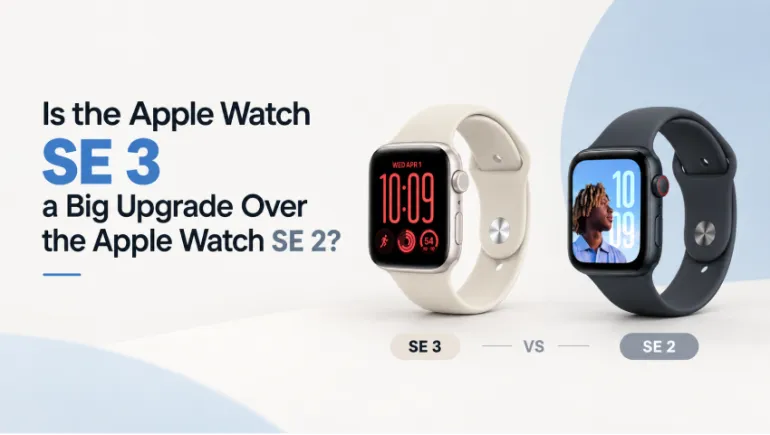
Apple Watch SE 3 keeps the same look as SE 2, but the chip, display, and health tracking have all moved forward. Here's what changed, and who should actually upgrade.
The Apple Watch SE line has always been Apple's answer to one question: how do you make a genuinely useful smartwatch without charging flagship prices? The Apple Watch SE 2 answered that well for three years. Now the Apple Watch SE 3 has arrived, and it brings some of Apple's newer flagship features down to the budget tier for the first time.
This article covers exactly what changed between the Apple Watch SE 3 and SE 2, what stayed the same, and whether the upgrade is worth it for your wrist.
There's no visual difference between the two watches when you look at them side by side. Apple Watch SE 3 keeps the same 40mm and 44mm aluminum cases, the same rounded square shape, and the same 10.7mm thickness. Apple did trim the color lineup down to two options, Midnight and Starlight, one fewer than SE 2 offered.
The one real design change is durability. SE 3 uses Ion-X glass that Apple says is four times more crack-resistant than the glass on SE 2. If you've ever worried about cracking your watch face on a doorframe or a gym rack, this is a meaningful, if invisible, improvement.
Both watches use the same LTPO OLED display technology and reach the same peak brightness of up to 1,000 nits, so raw display quality hasn't changed. What has changed is how the display behaves. Apple Watch SE 3 is the first SE model with an Always-On display, a feature previously reserved for the Series and Ultra lines. SE 2 only shows information when you raise your wrist or tap the screen.
This sounds like a small thing, but it changes how the watch feels day to day. With SE 2, your wrist is a blank screen until you move it. With SE 3, the time and your complications are always visible, which is the kind of change you notice constantly rather than occasionally.
Apple Watch SE 3 runs the S10 chip, the same chip found in the Apple Watch Series 10 and Ultra 3. SE 2 runs the older S8 chip, which has a smaller Neural Engine and noticeably less headroom for newer software. If your SE 2 has felt sluggish loading apps or processing Siri requests on recent watchOS versions, the S10 chip resolves that directly.
The new chip also enables features SE 2 simply can't run: on-device Siri processing, double-tap and wrist-flick gestures, and faster app launches. This is the upgrade that makes the rest of the list possible, similar to how a new chip unlocked new features on this year's Series and Ultra models.
Health tracking is where SE 3 pulls furthest ahead. Both watches still cover the basics: heart rate monitoring, sleep tracking, fall detection, and 50-meter water resistance for swimming. But SE 3 adds a wrist temperature sensor, which SE 2 doesn't have at all. That sensor powers three features new to the SE line: an all-new sleep score, retrospective ovulation estimates for cycle tracking, and FDA-cleared sleep apnea notifications.
The sleep apnea feature is worth calling out specifically. It works by tracking small disruptions in your breathing pattern during sleep and flagging signs that may indicate moderate to severe sleep apnea, prompting you to talk to a doctor. This same feature debuted on Apple's Series 10 watch, and now it's standard on the entry-level model too.
Both watches offer roughly the same all-day battery life, rated at up to 18 hours of typical use. The difference shows up in charging speed instead. Apple says SE 3 charges up to twice as fast as SE 2, so topping up before a workout or overnight takes noticeably less time, even though the total battery capacity and daily runtime haven't changed.
Apple Watch SE 3 supports 5G cellular connectivity on cellular models, while SE 2 is limited to 4G LTE. For most everyday tasks like receiving notifications or taking calls, you likely won't notice a dramatic difference. But if you rely on your watch's cellular connection while your phone is elsewhere, SE 3 will generally connect faster and more reliably in areas with strong 5G coverage.
Despite the upgrades, plenty carries over unchanged. Case sizes, aluminum build, 50-meter water resistance, and core safety features like fall detection and Emergency SOS are identical across both models. Storage remains at 64GB. If you were expecting a redesign, a bigger screen, or an entirely new look, SE 3 won't deliver one. This is an upgrade about what's inside the case, not how it looks on your wrist.
Apple Watch SE 3 launched on September 19, 2025, starting at $249 for the 40mm GPS model and $279 for the 44mm version, the same starting price as SE 2. In India, it launched at ₹25,900, and in Japan at ¥37,800. Apple has not listed official pricing for Bangladesh, so buyers there should check Apple's authorized resellers or import pricing for the most accurate local cost.
If you're buying your first Apple Watch, SE 3 is the easy choice, since it costs the same as SE 2 did and adds real, noticeable improvements. If you already own an SE 2, the decision depends on what bothers you most about it. If your watch feels slow, if you've wanted an Always-On display, or if sleep apnea alerts and deeper health data matter to you, SE 3 is a genuine, felt upgrade rather than a marketing refresh.
If your SE 2 still feels fast and you mainly use it for notifications, basic workouts, and telling time, you're not missing much by skipping this generation. The core experience hasn't changed enough to force an upgrade, especially since both watches share the same durable, comfortable design that made the SE line popular in the first place.




Comments
There are no comments for this Article.