




14 September 2026
|
8:10:45
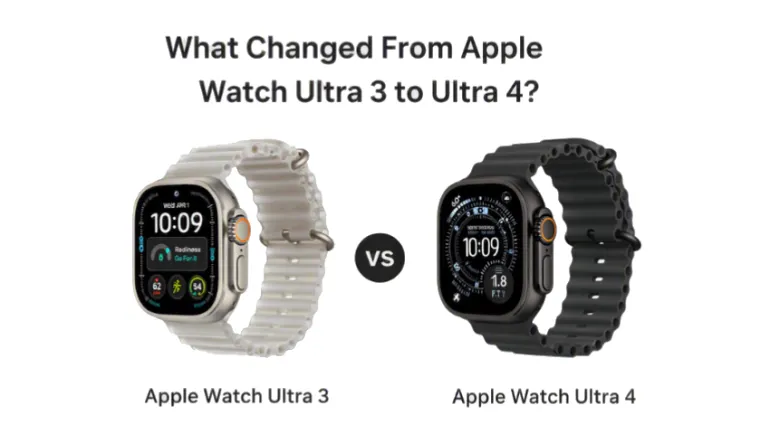
Apple Watch Ultra 4 keeps the same design as Ultra 3, but the chip, battery, and health sensors are all new. Here's what actually changed, and whether it's worth upgrading.
Apple Watch Ultra 4 looks nearly identical to Apple Watch Ultra 3 at first glance. Same 49mm titanium case. Same big display. Same $799 starting price. But look past the shell, and Apple has rebuilt almost everything that sits underneath it. The chip is new, the battery lasts longer, and the health sensors have been redesigned from the ground up.
This guide walks through every meaningful change between Apple Watch Ultra 4 and Ultra 3, so you can decide whether the upgrade is worth it for you.
If you own an Ultra 3, you won't need to adjust to a new look. Both watches use the same 49mm Grade 5 titanium case, the same sapphire crystal front, and the same two case colors. Water resistance stays at 100 meters, with recreational diving support down to 40 meters. Storage is unchanged at 64GB, and both models keep Wi-Fi 4, Bluetooth 5.3, and NFC.
The display is also carried over. Both watches use a 422 x 514 LTPO3 OLED panel with a 1,245mm² display area, 1Hz Always-On capability, and brightness up to 3,000 nits. In short, if you're buying the Ultra 4 for a new look, you'll be disappointed. The real story is what's happening inside the case.
Apple kept the same S10 chip in last year's Ultra 3, carried over from the 2024 model. That streak ends with Ultra 4. It ships with a brand-new S11 chip, which Apple calls its most powerful wearable chip to date. Apple hasn't published exact benchmark numbers, but the S11 also brings double the memory, jumping from 2GB in Ultra 3 to 4GB in Ultra 4.
That extra memory and processing power isn't just for show. It's what unlocks several of the software features covered below, including the new Readiness score and faster on-device processing for health data.
Battery life is where the upgrade becomes obvious in daily use. Apple Watch Ultra 3 lasts up to 42 hours on a charge, or 72 hours in Low Power Mode. Apple Watch Ultra 4 stretches that to 50 hours of normal use, and up to 84 hours in Low Power Mode.
Fast charging improves too. A 15-minute charge on Ultra 4 delivers around 18 hours of runtime, compared to 12 hours from the same charge time on Ultra 3. That's roughly 50% more battery from the same quick top-up, which matters if you're charging in a hurry before a workout or a flight.
GPS-specific battery life also improves. Ultra 3 was limited to about 14 hours of continuous GPS tracking, which meant athletes doing full-distance triathlons sometimes had to switch to Low Power Mode partway through. Ultra 4 extends outdoor workout tracking to around 18 hours at full GPS accuracy, and its new Extended Workout and Max Extended Workout modes push endurance further for ultramarathons and multi-day events, though with reduced metrics and alerts during those modes.
This is the category where Ultra 4 makes its strongest case. Apple redesigned the entire sensor stack for this generation, calling it the new Health Sensing System. The optical heart rate sensor now has a larger electrode surface area for better skin contact, photodiodes arranged in a ring for more efficient light capture, and more power-efficient LEDs.
The practical result is more frequent, more accurate readings. Heart rate is now measured as often as every five seconds, and heart rate variability, a key marker of rest and recovery, is measured up to every five minutes. Apple has also cited an internal study of more than 1,000 participants, conducted in mid-2026, claiming Apple Watch now offers the most accurate heart rate sensing of any wearable tested. Apple hasn't published how Ultra 3 performed in that same study, so it's not possible to confirm the size of the improvement independently yet.
On the software side, Ultra 4 introduces a Readiness score, a feature many other fitness wearables have offered for years. It analyzes your recent training load, vitals, and sleep to estimate how prepared your body is for the day ahead, feeding into the existing Vitals app. A new Health Age feature compares your current fitness markers against others in your age group. Apple has not confirmed whether Readiness or Health Age will come to Ultra 3 through a software update.
Apple's satellite and GPS hardware is unchanged between the two models. Both use the same precision dual-frequency GPS system. What's different is how long that GPS can run before the battery forces a compromise. Because Ultra 4's battery lasts longer, it can sustain full-accuracy GPS tracking for longer sessions without switching to a lower-accuracy power-saving mode, which is the real-world upgrade for endurance athletes rather than a change in raw positioning accuracy.
Both watches run watchOS 27, which arrived as a free update for Ultra 2 and later. That means Ultra 3 owners get several new features too, including Siri with personal context in beta, a redesigned dynamic app grid, single-handed tap gestures for the Smart Stack, and Workout Buddy without needing a nearby iPhone. The new Health app's Longevity tab also works on existing Apple Watch models.
What's exclusive to Ultra 4, at least for now, is the Readiness score, the extended 18-hour GPS workout ceiling, and the Extended and Max Extended Workout modes. Apple hasn't ruled out bringing some of these to Ultra 3 later, but nothing has been confirmed.
If you're buying your first Apple Watch Ultra, the choice is straightforward. Ultra 4 costs the same as Ultra 3 did at launch, so there's little reason to buy the older model when it's available.
If you already own an Ultra 3, the upgrade is less clear-cut. The design, display, and core hardware haven't changed, so you won't notice a difference just by wearing it. The case for upgrading comes down to two things: whether the longer battery life and extended GPS workout window solve a real problem for you, and whether Readiness and the new health sensor accuracy would actually change how you train or recover. If neither of those points speaks to your routine, Ultra 3 remains a capable, current watch, especially since watchOS 27's headline software features already reach it.
Specifications and figures in this article are based on Apple's official announcements and independent reporting at launch. Some comparative claims, including Apple's heart rate accuracy study, have not been independently verified across both generations.










Comments
There are no comments for this Article.