


A fanless, GPU-powered computer is headed to the lunar south pole. Its job: prove that AI can think for itself where help from Earth is slow and far away.
Hewlett Packard Enterprise (HPE) announced the Spaceborne Computer-4 on October 20, 2026. It's a compact computer module that will ride on a rover to the Moon, where it will run artificial intelligence and, HPE says, the first high-performance computing benchmarks ever attempted on the lunar surface.
This article explains what the system is, what it will test, the challenges it faces, and why the mission matters.
What Is HPE Spaceborne Computer-4?
The Spaceborne Computer-4 is a purpose-built compute module for the lunar environment. HPE describes it as lightweight, self-contained, and fanless. It uses a GPU, which handles many calculations at once and suits AI and image processing. It draws power from the rover's batteries and solar panels and connects to the rover's thermal system. KIOXIA SSDs provide storage.
HPE has sent computers to the International Space Station for years. This model moves beyond that, into a place with no atmosphere and much higher radiation exposure.
The Mission: Rover, Lander, and Timeline
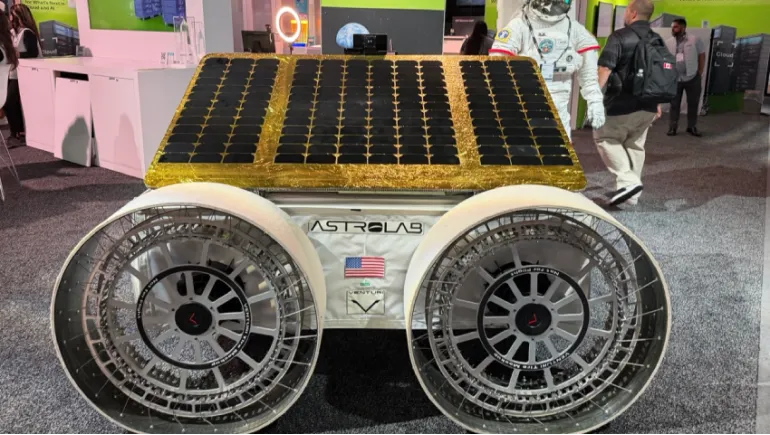
The computer will fly as a payload on Astrolab's FLIP rover, short for Flex Lunar Innovation Platform. Astrobotic's Griffin-1 lander will carry FLIP near the Moon's south pole, reportedly in the Mons Mouton area. The trip is part of NASA's Commercial Lunar Payload Services program.
FLIP weighs about 480 kg, carries roughly 20 payloads, and is built to last about a year. Reports say launch could happen as early as November on a Falcon Heavy rocket, with a landing before the end of 2026. Space schedules often slip, so treat those dates as targets.
What Will It Do on the Moon?
- Language-model tests: Retrieval-augmented generation, which lets an AI answer questions by searching documents
- Vision inference: AI analysis of images from the rover's cameras
- LiDAR processing: Data used for mapping, navigation, terrain analysis, and infrastructure planning
- AI services container: A demonstration of deploying scalable AI applications on the Moon
- Benchmarks: HPE's claimed first supercomputer benchmarks on the lunar surface
NASA will also run its FLUID experiment, which coordinates three AI models trained on data from Earth, the Moon, and the space station. Deloitte will deploy additional AI workloads.
Why Process Data on the Moon?
Data rates from the south pole back to Earth are slow. Sending every camera frame and sensor reading home wastes bandwidth. Astrolab's CEO says local processing saves that bandwidth, which is the core idea of edge computing in space. The rover can analyze data itself and send back only what matters.
Built for Extreme Conditions
The Moon is harsh for electronics. There's no air, so fans can't move heat, which is why a fanless design matters. Radiation is stronger than on the space station. Temperatures swing widely, and power is limited. HPE says it adapted the module to the rover's power, heat, and form-factor limits. Engineers on Earth will manage workloads remotely from Astrolab's mission control in Hawthorne, California.
How It Differs From Earlier Spaceborne Computers
Earlier Spaceborne Computers operated inside the space station, with the station providing shelter, air, and power. Spaceborne Computer-4 operates on an open lunar surface, exposed to the environment and tied to a moving rover. HPE hasn't published a detailed performance comparison with earlier models, so claims of speed gains remain unverified.
Risks and Open Questions
- Landing risk: Every lunar landing carries a chance of failure.
- Dates: Launch and landing windows can change.
- "First" claims: The benchmark claim comes from HPE and hasn't been tested yet.
- Results: No performance data exists until the system operates on the Moon.
Why It Matters
Future lunar bases will need machines that can map terrain, navigate, and analyze science data without waiting for Earth. If this test works, engineers gain a proven design for AI hardware on the Moon. The results could also guide AI computing for other harsh, disconnected places on Earth.
The Spaceborne Computer-4 is an ambitious experiment, not a finished product. Its value depends on a successful landing and real results. Watch for launch updates and published benchmark data, which will show whether AI computing on the Moon is practical.











Comments
There are no comments for this Article.