




25 September 2026
|
8:10:45
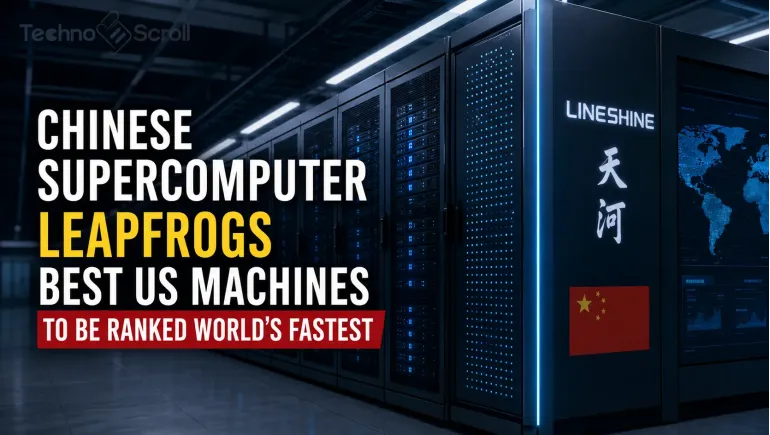
China has reclaimed the global supercomputing crown after its newly unveiled LineShine supercomputer secured the No. 1 position on the latest TOP500 rankings, overtaking the United States' El Capitan system. The achievement marks China's return to the top of the world's most prestigious supercomputer list for the first time since 2017 and underscores the country's growing capabilities in high-performance computing (HPC).
The TOP500 list, released during the International Supercomputing Conference (ISC) in Hamburg, ranks the world's fastest supercomputers based on the High Performance Linpack (HPL) benchmark, an industry-standard test used to measure raw computational performance.
China's LineShine delivered an impressive 2.198 exaflops of sustained computing performance, meaning it can execute more than 2.19 quintillion calculations per second. That performance surpassed El Capitan, the U.S. supercomputer housed at Lawrence Livermore National Laboratory, which previously held the top position.
One of LineShine's most notable characteristics is its architecture. Unlike most modern exascale systems that rely heavily on GPUs for acceleration, LineShine achieves its record-breaking performance using CPU-only architecture built on domestically designed processors. The system reportedly contains nearly 14 million processing cores while consuming approximately 42.2 megawatts of power.
The ranking represents more than just a technological achievement. It reflects China's continued push toward semiconductor self-reliance amid ongoing U.S. export restrictions on advanced chips and computing technologies.
Industry analysts note that LineShine demonstrates China's ability to develop world-class high-performance computing infrastructure using homegrown technology. The achievement also strengthens Beijing's position in scientific research, climate modeling, engineering simulations, and other computationally intensive fields.
Although topping the TOP500 list is a major accomplishment, experts caution that it should not be confused with leadership in artificial intelligence.
The TOP500 benchmark primarily measures traditional scientific computing performance rather than AI workloads. Modern AI training typically depends on massive GPU clusters optimized for low-precision calculations, an area where GPU-accelerated systems generally outperform CPU-only machines.
In fact, while LineShine leads the HPL benchmark, it ranks lower on AI-oriented performance tests, highlighting the growing distinction between traditional supercomputing and AI infrastructure.
China's latest victory intensifies the technological competition between the world's two largest economies. While the United States continues to dominate AI hardware and cloud infrastructure through companies such as NVIDIA, Google, Microsoft, and Amazon, China is steadily advancing its domestic computing ecosystem despite export controls.
As scientific research, national security, and artificial intelligence increasingly rely on extreme computing power, future leadership will likely depend not only on benchmark performance but also on energy efficiency, AI acceleration, semiconductor innovation, and software ecosystems.
China's LineShine may now hold the title of the world's fastest publicly ranked supercomputer, but the broader race for next-generation computing leadership is far from over.












Comments
There are no comments for this Article.