




22 September 2026
|
8:10:45
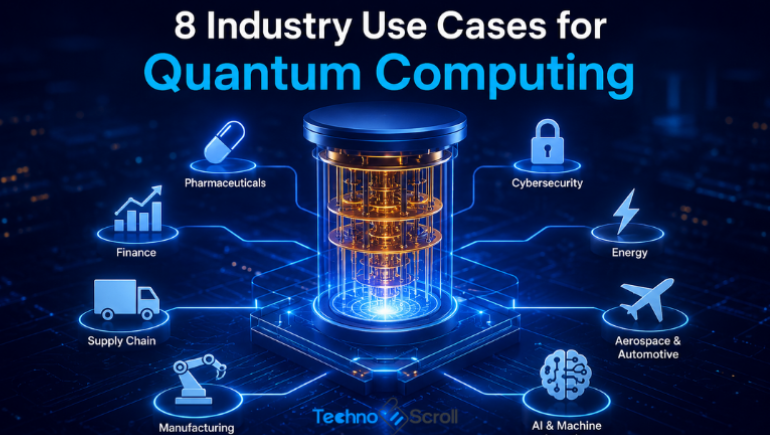
Quantum computing is rapidly evolving from a theoretical concept into a transformative technology with the potential to reshape entire industries. Unlike classical computers that process information using bits, quantum computers leverage quantum bits (qubits), enabling them to perform highly complex calculations at unprecedented speeds. While large-scale commercial adoption is still developing, organizations across multiple sectors are already exploring practical applications that could deliver significant competitive advantages.
Here are 8 industry use cases where quantum computing is expected to create substantial impact.
The pharmaceutical industry faces enormous challenges in discovering and developing new medicines. Traditional computational methods often struggle to accurately simulate molecular interactions because of their complexity.
Quantum computing can model molecular structures and chemical reactions at a much deeper level. This capability could help researchers identify promising drug candidates faster, reduce development costs, and improve treatment effectiveness. By accelerating molecular simulations, pharmaceutical companies may significantly shorten the timeline from laboratory research to market-ready therapies.
Financial institutions constantly seek ways to maximize returns while minimizing risk. Portfolio optimization requires analyzing countless variables, market conditions, and investment combinations.
Quantum algorithms can evaluate a vast number of possible scenarios simultaneously, enabling more sophisticated portfolio management strategies. Banks, investment firms, and asset managers could use quantum computing to improve risk assessment, optimize asset allocation, and enhance trading strategies in increasingly complex financial markets.
Modern supply chains involve thousands of interconnected variables, including transportation routes, inventory levels, warehouse operations, and demand forecasting.
Quantum computing can solve optimization problems that are extremely difficult for conventional systems. Logistics providers may use quantum-powered solutions to identify the most efficient delivery routes, reduce fuel consumption, improve inventory planning, and minimize operational costs. These improvements could lead to faster deliveries and greater supply chain resilience.
Manufacturers continuously work to improve production efficiency, reduce waste, and enhance product quality. However, optimizing complex production systems often requires processing massive datasets and evaluating countless operational scenarios.
Quantum computing can help manufacturers model production environments more accurately and identify optimal configurations for machinery, workflows, and resource allocation. This capability can support predictive maintenance, improve quality control, and increase overall manufacturing efficiency.
As digital threats become more sophisticated, organizations require stronger security mechanisms to protect sensitive information. Quantum computing presents both challenges and opportunities for cybersecurity.
While future quantum systems may eventually break some traditional encryption methods, quantum technologies are also driving the development of quantum-resistant cryptography and advanced security protocols. Industries handling critical data, including finance, healthcare, and government agencies, are investing in quantum-safe security frameworks to prepare for the next generation of cyber threats.
Energy providers manage highly complex networks involving power generation, transmission, storage, and distribution. Optimizing these systems requires processing enormous amounts of operational data.
Quantum computing can help improve grid management, energy forecasting, and resource allocation. Utility companies may leverage quantum technologies to balance energy supply and demand more effectively, integrate renewable energy sources, and reduce operational inefficiencies. These advancements could contribute to more sustainable and reliable energy systems.
Designing aircraft, spacecraft, and next-generation vehicles requires extensive simulation and testing. Engineers must evaluate aerodynamics, materials performance, battery efficiency, and numerous other factors.
Quantum computing can accelerate complex engineering simulations and support the discovery of advanced materials with enhanced properties. Aerospace and automotive companies could use these capabilities to develop lighter components, improve fuel efficiency, optimize electric vehicle batteries, and reduce product development timelines.
Artificial intelligence relies on processing large datasets and training sophisticated models. As AI applications become more advanced, computational demands continue to grow.
Quantum computing has the potential to enhance machine learning by accelerating data analysis, pattern recognition, and optimization tasks. Organizations may use quantum-enhanced AI systems to improve predictive analytics, customer insights, fraud detection, and decision-making processes. The convergence of quantum computing and AI could unlock entirely new capabilities across multiple industries.
Although quantum computing remains in its early stages, its potential impact is becoming increasingly clear. From healthcare and finance to manufacturing and energy, organizations are actively exploring how quantum technologies can solve problems that are beyond the reach of traditional computing systems.
As hardware capabilities improve and quantum algorithms mature, businesses that invest in understanding and preparing for this technology today may be better positioned to capitalize on future breakthroughs. Quantum computing is not merely an incremental advancement it represents a fundamental shift in computational power that could redefine innovation across industries for decades to come.












Comments
There are no comments for this Article.