




13 September 2026
|
8:10:45
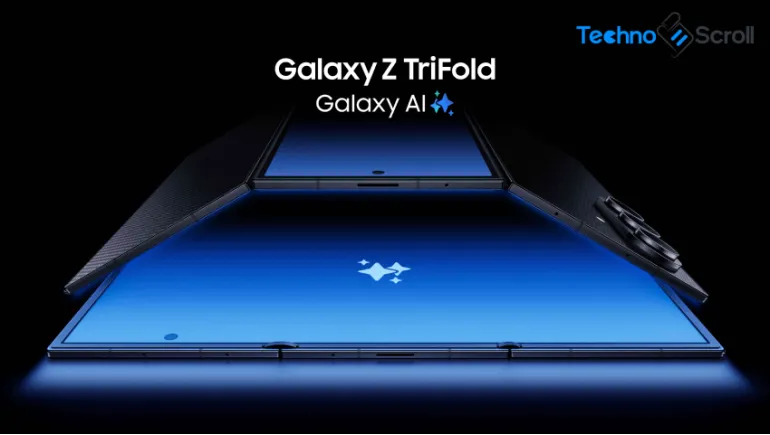
Samsung has officially entered a new category of mobile devices with the Galaxy Z TriFold, its first phone to fold not once, but twice. Unlike the Galaxy Z Fold and Z Flip, which have defined Samsung's foldable lineup for years, the Z TriFold unfolds into a 10-inch tablet-sized display while still closing down into a pocketable phone. It's an ambitious, expensive, and genuinely new kind of device. Here's a complete breakdown of what it offers, how much it costs, and who it's actually built for.
The Galaxy Z TriFold is Samsung's first triple-fold smartphone, using two inner hinges to transform a compact phone into a large tablet. Closed, it functions like a normal premium phone with a 6.5-inch cover screen. Fully unfolded, it becomes a 10-inch display, the largest screen ever placed on a Galaxy device. Samsung has positioned the device less as a mass-market flagship and more as a technology showcase, with Counterpoint Research analyst Liz Lee noting at the launch event that scale isn't the objective for this first-generation model.
Samsung confirmed the Galaxy Z TriFold launched first in South Korea on December 12, 2025. It later expanded to other Asian markets, including China, Taiwan, Singapore, and the UAE, before arriving in the United States on January 30, 2026. Notably, the phone is sold exclusively through Samsung Experience Stores and Samsung.com in the US, and it is not available through mobile carriers.
Pricing is where the TriFold makes its boldest statement. In South Korea, the device launched at KRW 3,594,000, roughly $2,450. In the United States, Samsung set the price significantly higher at $2,899 for the 16GB RAM and 512GB storage configuration, making it the most expensive smartphone ever sold by Samsung, and pricier than even a fully loaded iPhone 17 Pro Max. The US version comes in a single Black color option, while global buyers can also get a 1TB storage variant. The package includes a Carbon Shield case, a 45W fast charger, and a data cable as standard inclusions.
Despite folding twice, the Galaxy Z TriFold measures just 3.9mm at its thinnest point when fully unfolded, and around 12.9mm thick when folded, only slightly thicker than the single-fold Galaxy Z Fold6. The device uses an Advanced Armor Aluminum frame and Corning Gorilla Glass Ceramic 2 for its outer screen, with an Armor FlexHinge system engineered to handle up to 200,000 folds over its lifetime. It weighs 309 grams and carries an IP48 rating, meaning it's protected against water exposure, though not against dust.
Samsung has also acknowledged durability concerns tied to complex folding mechanisms by offering a one-time 50% discount on display repair costs if the screen breaks, a notable gesture of confidence in a first-generation product.
The Galaxy Z TriFold's headline feature is its display. When closed, it uses a 6.5-inch Dynamic AMOLED 2X cover screen with a 2,520 x 1,080 resolution, a 1-120Hz adaptive refresh rate, and peak brightness up to 2,600 nits. Fully unfolded, the internal display expands to a massive 10-inch QXGA+ panel at 2,160 x 1,584 resolution, with a 120Hz refresh rate and up to 1,600 nits of peak brightness. This makes it the largest main screen ever featured on a Galaxy foldable, well beyond the Z Fold7's 8-inch internal display.
Under the hood, the Galaxy Z TriFold runs on a customized Snapdragon 8 Elite chipset, built on a 3nm process and tuned specifically to handle the performance demands of a tri-folding form factor. It ships with 16GB of RAM and either 512GB or 1TB of storage, with no microSD card slot for expansion. The device runs Android 16 with One UI 8 out of the box, and Samsung has committed to seven years of major OS updates, meaning it should remain supported until at least 2032.
Battery life is handled by a 5,600mAh battery, the largest ever included in a Samsung foldable, supporting up to 17 hours of video playback and 45W Super Fast wired charging capable of reaching 50% in around 30 minutes.
The Galaxy Z TriFold's rear triple camera system includes a 200MP Wide sensor with OIS, a 12MP Ultra Wide lens, and a 10MP Telephoto lens with 3x optical zoom and up to 30x Space Zoom. It supports 8K video recording at 30fps and 4K at 60fps across all lenses, along with HDR10+ recording. A 10MP selfie camera sits on the cover screen. Samsung's ProVisual Engine and Galaxy AI photo tools, including Generative Edit and Sketch to Image, are built directly into the camera experience.
No. Despite its large canvas seemingly inviting stylus use, the Galaxy Z TriFold does not support the S Pen, matching Samsung's decision with the Galaxy Z Fold7. This may disappoint productivity-focused buyers who expected stylus input on a device this size, though Samsung has instead focused on touch-based multitasking and Samsung DeX as the productivity centerpiece.
One of the TriFold's most significant software features is standalone Samsung DeX, accessible directly from the Quick Settings panel without needing an external monitor. DeX transforms the 10-inch display into a desktop-style interface with resizable windows, a taskbar, and support for a connected keyboard and mouse. On the Galaxy Z Fold7, DeX typically requires an external display to feel practical; on the TriFold, the screen itself is large enough to make desktop-style multitasking genuinely usable on the go.
Beyond DeX, the device supports up to four Multi Workspaces, each capable of running up to five apps simultaneously, along with the ability to run three full-sized apps side by side in portrait mode.
The Galaxy Z TriFold ships with Samsung's full Galaxy AI suite, built in partnership with Google. Buyers get six months of Google AI Pro included, along with tools like Generative Edit, Circle to Search, and live translation. Samsung has also emphasized Note Assist features that can transcribe meetings directly on the large display and convert highlighted content into formatted documents or presentation slides, leaning into the device's productivity-first positioning.
Compared to the Galaxy Z Fold7, the TriFold's clearest advantage is screen size: a 10-inch unfolded display versus 8 inches on the Fold7. Both devices share an identical 200MP, 12MP, 10MP triple camera setup and lack S Pen support. The TriFold adds standalone Samsung DeX without needing an external screen, a meaningful upgrade over the Fold7's DeX experience. However, the TriFold is noticeably more expensive and slightly thicker when folded, trading some portability for its larger productivity-focused canvas.
For most people, the answer is no, and that's by design. This is a first-generation showcase device aimed at professionals who genuinely need a tablet-sized screen in their pocket, not a phone intended for mass adoption. If you value standalone desktop-style productivity, a massive display for multitasking, and don't mind paying a premium for genuinely new technology, the Z TriFold delivers an experience no other phone currently matches. If your priority is value, S Pen support, or a more pocketable foldable, the Galaxy Z Fold7 remains the more practical choice at a significantly lower price.











Comments
There are no comments for this Article.