




12 October 2026
|
8:10:45
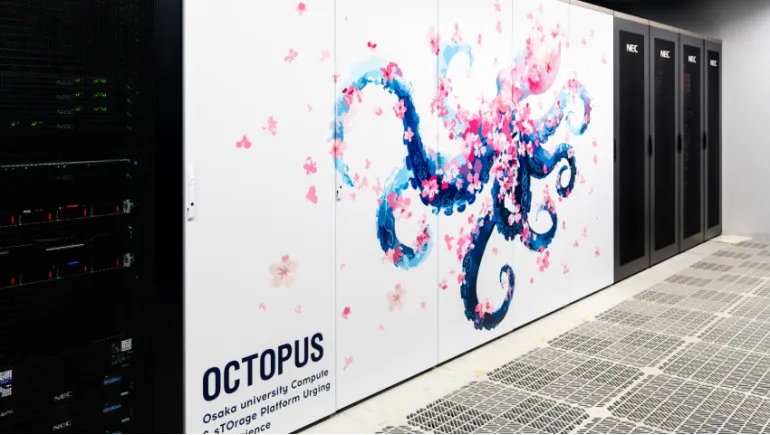
The future of scientific research demands more than raw computational power it requires transparency, reproducibility, and collaboration. NEC Corporation has delivered the OCTOPUS supercomputer to Osaka University's D3 Center, marking a significant advancement in open science infrastructure. This next-generation high performance computing (HPC) platform represents a paradigm shift in how researchers approach computational science.
OCTOPUS, which stands for Osaka University Compute and sTOrage Platform Urging open Science, began trial operations in September 2025, with full-scale operations launching in December. The Osaka University supercomputer goes beyond traditional computational capabilities by addressing one of science's most pressing challenges: ensuring research reproducibility and transparency.
The 2.293 petaflops OCTOPUS supercomputer delivers approximately 1.5 times the performance of its predecessor while introducing groundbreaking features that transform how scientific data is tracked and verified. Located at the Ibaraki City Osaka D3 Center, the system consists of general-purpose CPU nodes equipped with two 6th generation Intel Xeon Scalable processors (Granite Rapids generation) and large-capacity storage with an effective capacity of 3.58 PB.
What truly distinguishes the NEC OCTOPUS supercomputer from other research computing infrastructure is its innovative provenance management capabilities. The system incorporates a provenance management function that automatically records and manages processes such as data generation, jointly developed by Osaka University and NEC.
This computational provenance management supercomputer addresses critical concerns in modern research. Academic research involves the daily analysis and generation of vast amounts of data using supercomputers, yet research processes and results are often left to manual recording, raising concerns about reproducibility, fairness, and efficiency.
The provenance management function automatically records data generation, creating a comprehensive computation history tracking system. SCUP-HPC tracks what data is accessed by which programs and what data is generated on cluster-type supercomputers while minimizing the impact on performance. This enables Scientific Computing Unifying Provenance – High Performance Computing.
The NEC LX201Ein-1 supercomputer consists of 140 computing nodes, each featuring dual Intel Xeon Scalable processors from the Granite Rapids generation. This architecture optimizes the system for diverse scientific workloads without relying on GPU accelerators.
The Osaka University D3 Center computing platform achieves its theoretical performance through an intelligent design focused on general-purpose HPC workloads. The 3.58 PB effective storage capacity ensures researchers can manage massive datasets from molecular simulations to climate modeling.
This configuration makes the Osaka supercomputer particularly suitable for traditional HPC applications while maintaining cost efficiency. High-speed networking enables seamless data exchange across all nodes.
The OCTOPUS platform introduces provenance visualization and reproducibility features that fundamentally transform research verification. Authorized users can search using history IDs and view visualized computational provenance, enabling researchers to include computation history IDs in academic publications.
This approach creates unprecedented transparency. When findings are published, peers can verify exactly how results were generated, addressing long-standing concerns about reproducibility in computational science.
By shifting from manual documentation to automated tracking, OCTOPUS ensures scientific integrity without adding administrative burdens to researchers.
The Osaka University HPC infrastructure operates as a true open science platform, promoting data sharing and collaborative research across institutions. OCTOPUS contributes to open science by enabling research data to be shared across society.
As a national joint-use facility, the Osaka Prefecture supercomputer is accessible to universities, research institutes, and companies across Japan, democratizing access to petaflop-scale computing resources.
The platform supports a wide range of research domains, from classical physics simulations to AI and big data analytics, enabling breakthrough discoveries.
At the core of OCTOPUS lies SCUP-HPC (System for Constructing and Utilizing Provenance on High-Performance Computing Systems). This collaborative research between Osaka University and NEC was published in IEEE Access on August 11, 2025.
SCUP-HPC enables detailed provenance tracking without degrading performance, a critical requirement for production supercomputer environments. Researchers can trace outputs back through the complete chain of computational steps, enabling unparalleled verification and reproducibility.
NEC continues advancing research computing under its value creation model NEC BluStellar. The company plans to commercialize the provenance management system, potentially bringing these capabilities to supercomputers worldwide.
NEC recognizes that modern research requires more than performance it requires transparency, collaboration, and trust. OCTOPUS embodies these principles in its architecture and functionality.
The NEC OCTOPUS supercomputer arrives at a pivotal moment in scientific computing. As computational research grows in scale and complexity, reproducibility and data integrity have become critical concerns.
With 2.293 petaflops of theoretical performance, OCTOPUS enables advanced simulations, higher-resolution climate models, and more sophisticated AI research. Its provenance capabilities may prove to be its most enduring contribution.
The Osaka University supercomputer supports a wide spectrum of disciplines, from fundamental science to applied engineering and industrial research. Its general-purpose CPU design ensures adaptability to evolving computational methods.
The system accommodates AI and big data workloads alongside traditional HPC applications, ensuring long-term relevance and versatility.
The launch of OCTOPUS signals a broader shift in high performance computing priorities. Future supercomputers will increasingly integrate data provenance, transparency, and reproducibility as core features.
The collaboration between Osaka University and NEC demonstrates how academia and industry can jointly develop solutions to global research challenges. OCTOPUS may serve as a model for next-generation research computing infrastructure worldwide.












Comments
There are no comments for this Article.