




11 October 2026
|
8:10:45
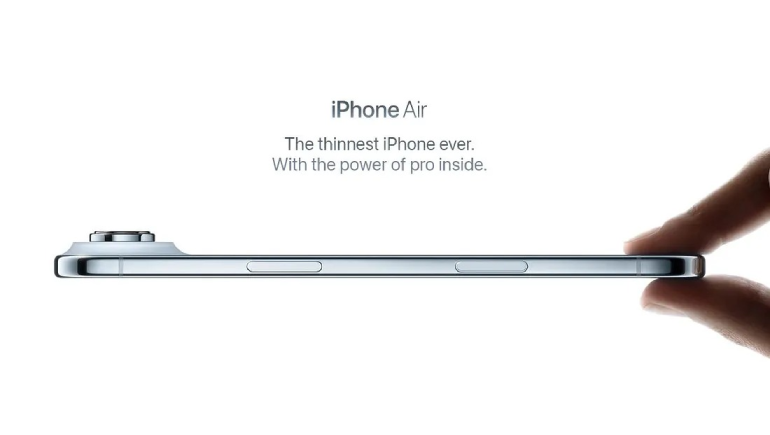
Apple has redefined the smartphone silhouette with the debut of the iPhone Air, the thinnest device in the company's history. Measuring just 5.6mm thick, the iPhone Air is a significant departure from the standard iPhone 17’s 7.8mm profile. To put this into perspective, its width is roughly equivalent to three wooden toothpicks or seven razor blades. This breakthrough design is not just a feat of aesthetics but a showcase of innovative internal architecture and advanced materials.
The iPhone Air features a Grade 5 titanium frame with an elegant high-gloss mirror finish. To achieve its slim profile, Apple utilized an eSIM-only design, which saves critical internal space. On the back, a precision-milled "plateau" houses the cameras, speakers, and Apple silicon, a design choice that maximizes the remaining space for the battery.
Despite its thinness, the Air is built for durability. It introduces Ceramic Shield 2 on the front cover, which provides 3x better scratch resistance than previous models. For the first time, Ceramic Shield also protects the back of the device, offering 4x better resistance to cracks. In rigorous testing, the iPhone Air withstood 190 lbs of pressure before bending, proving it is as resilient as much thicker models..
The device boasts a 6.5-inch Super Retina XDR display featuring ProMotion technology. This allows for an adaptive refresh rate of up to 120Hz for fluid scrolling, which can scale down to 1Hz to efficiently power the Always-On display. It is the brightest display ever on an iPhone, reaching 3,000 nits of peak outdoor brightness with 2x better outdoor contrast.
Looking ahead, reports suggest Apple may introduce LTPO3 OLED technology by 2027. This next-generation display would incorporate oxide semiconductors in all transistors to further reduce battery consumption a critical advancement for ultra-thin devices where battery volume is limited.
The iPhone Air is powered by a specialized configuration of the A19 Pro chip, featuring a 6-core CPU and a 5-core GPU. This architecture includes Neural Accelerators built into each GPU core, delivering up to 3x the peak compute power for generative AI models.
Complementing the A19 Pro are two new Apple-designed chips:
To maintain a slim form factor, the iPhone Air utilizes a single 48MP Fusion Main camera rather than a multi-lens array. This versatile system uses a large quad-pixel sensor and sensor-shift optical image stabilization to excel in low light. It effectively offers the equivalent of four focal lengths, including an optical-quality 2x Telephoto.
On the front, the Air introduces an 18MP Center Stage camera with a square sensor. This allows users to take landscape-style selfies or video calls even while holding the phone vertically. The system uses AI to automatically expand the field of view to include everyone in a group shot.
A primary challenge for a 5.6mm phone is battery life. Apple has addressed this through software optimizations and a redesigned internal architecture. The iPhone Air is rated for 27 hours of video playback. In independent testing involving continuous web surfing over 5G, the device lasted 12 hours and 2 minutes. While this trails the larger iPhone 17 Pro Max, it remains competitive with other modern flagships.
The iPhone Air also advances Apple's environmental goals. It is made with 35% recycled content, including 80% recycled titanium the highest ever for an iPhone and 100% recycled cobalt in the battery. Even the USB Type-C port is 3D-printed to be thinner and stronger while using 33% less material.
The device ships with iOS 26, which features a new "Liquid Glass" design that makes the interface more expressive. This update includes enhanced Apple Intelligence capabilities, such as Live Translation in Messages and FaceTime, and advanced visual search tools.
A new ecosystem of accessories has been designed specifically for the Air, including:
The iPhone Air represents a minimalist future where pro-level performance and durability are no longer tied to a bulky design. It is a device built for those who prioritize lightweight elegance and the cutting edge of mobile engineering.
The iPhone Air is more than just a standalone release; it represents a new architectural path for Apple that prioritizes extreme portability without sacrificing professional capability. While the current 5.6mm design is a breakthrough, the evolution is set to continue with even more advanced power efficiency. By 2027, Apple is expected to introduce LTPO3 OLED displays to the Air lineup, a technology that utilizes oxide semiconductors to drastically cut power consumption, particularly during low refresh rates like the 1Hz Always-On display. This advancement, which has already been successfully implemented in the Apple Watch Series 10, is considered critical for ultra-thin devices where internal battery volume is naturally limited. As Apple continues to refine its custom silicon and display technology, the iPhone Air stands as a bold statement that the next era of smartphones will be defined by "impossibly thin" designs that truly feel like you are holding the future.












Comments
There are no comments for this Article.