




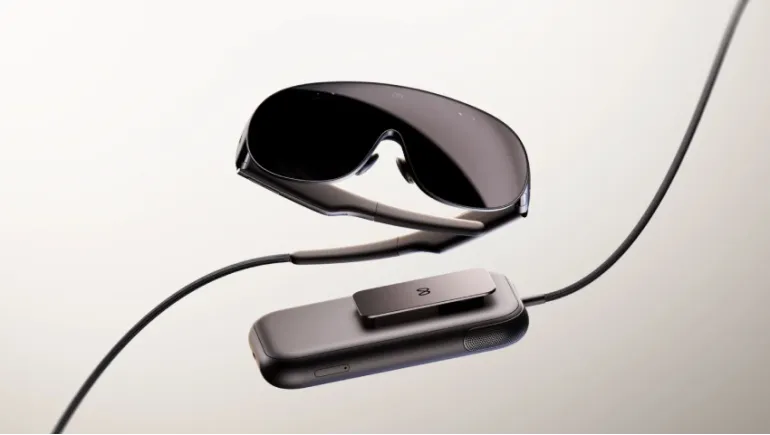
Meta just split a VR headset into two pieces, and the result weighs about as much as a deck of cards. Here's what the new Meta VR Glasses actually offer, and whether the tradeoffs make sense.
Meta has spent a decade trying to convince people that strapping a computer to their face is worth it. At Meta Connect 2026, held September 23 in Menlo Park, the company tried something different. Instead of making Quest lighter, Meta took the compute, battery, and storage out of the headset entirely, packed it into a separate pocket-sized puck, and left the glasses themselves weighing about 100 grams.
CEO Mark Zuckerberg introduced the device simply as Meta VR Glasses, calling it roughly five times lighter than Meta's own Quest 3. It's a direct shot at the entire premise of bulky VR hardware, and at Apple's Vision Pro specifically. Here's exactly what Meta announced, what's confirmed, and what's still unclear.
What Are Meta VR Glasses?
Meta VR Glasses use a split architecture that separates the parts of a VR headset that generate heat and add weight from the parts that sit on your face. The glasses themselves house the displays and sensors. A separate compute puck, connected by an optical tether, handles processing, battery, and storage. Meta says this design is the reason the glasses weigh close to 100 grams, compared to 515 grams for the existing Quest 3 headset.
That weight difference isn't a minor spec bump. Angela Chang, who oversees VR product management at Meta, explained the strategy directly: despite Quest selling tens of millions of units, plenty of would-be buyers skipped it because the weight made it uncomfortable to wear through an entire movie or work session. Meta VR Glasses are built specifically to answer that complaint, not to replace Quest as a gaming-first headset.
Meta VR Headset Specs: Display, Chip, and the Compute Puck
The glasses use micro-OLED panels, with Meta describing the display as a 5K Infinite Display, though some outlets covering the reveal have cited a 2.4K micro-OLED figure instead, so it's worth treating the exact resolution figure as still settling as more hands-on coverage arrives. The system runs on Qualcomm's new Snapdragon Reality Elite processor, paired with 12GB of RAM and 128GB of storage housed inside the puck rather than the glasses.
The puck itself supports up to three hours of continuous high-resolution media playback and charges quickly, supporting 45-watt fast charging. Because the puck absorbs the battery and processing load, Meta was able to give the glasses themselves a fanless, passively cooled design built around a magnesium-alloy frame, according to reporting from UploadVR and Road to VR.
Meta VR Glasses vs. Meta Quest 3: What Changes
The headline difference is weight: 100 grams versus 515 grams, a reduction Meta says makes the glasses roughly five times lighter than Quest 3. But Meta has been clear that this isn't a Quest 3 replacement. The company plans to continue developing the Quest line separately, running a two-product strategy rather than retiring headset-style VR in favor of glasses.
Input methods shift too. Meta VR Glasses rely primarily on eye tracking and fingertip gestures rather than handheld controllers, with Meta stating that more than 75 games are playable using hand gestures alone. That said, the hardware isn't gesture-only. It natively supports separately purchased Meta Touch Plus controllers for games and apps that need more precise input, and the device runs the same underlying operating system as Quest, giving it access to Meta's existing software library rather than launching with a separate, smaller app ecosystem.
Meta VR Glasses vs. Apple Vision Pro
Every major outlet covering this launch drew the same comparison, and for good reason. At $1,299.99, Meta VR Glasses cost roughly a third of Apple's $3,699 Vision Pro, while weighing, by some estimates, around a sixth as much. Those comparative weight and price ratios come from outlets like AppleInsider rather than a direct joint comparison from either company, so they're worth treating as directional figures rather than lab-verified numbers. Still, the gap is large enough that the general comparison holds regardless of the exact multiplier.
Meta VR Glasses are also the first VR device to receive IMAX Enhanced certification, a detail aimed squarely at positioning the device as a premium media and entertainment platform, not just a gaming accessory. Disney+ is bringing selected 3D movies to the platform, and Meta says the system will support more than 100 immersive live sports events per year through partners including ESPN and TNT Sports.
Meta VR Headset Price and Release Date
Meta VR Glasses will go on sale in spring 2027 for $1,299.99 in the United States. The device is planned for launch in 13 countries, including Japan, though Meta has only confirmed US dollar pricing so far; pricing for other regions, including Canada, had not been announced at the time of the reveal. That leaves a gap of several months between the announcement and actual availability, so this is very much a preview of what's coming rather than a device you can buy today.
Is the Meta VR Headset Worth Waiting For?
That depends entirely on what frustrates you about VR today. If the core issue has been comfort, the strain of wearing a heavy headset for an hour-long movie or a long work session, Meta VR Glasses are built to solve exactly that problem, and the 100-gram figure is a genuinely significant engineering claim if it holds up in real-world use. If your priority is competitive gaming or precise controller-based interaction, the shift toward gesture and eye tracking as primary inputs is a bigger adjustment, even with Touch Plus controller support available as a fallback.
It's also worth remembering this device won't ship for months, and several of the more granular specs, like the exact display resolution, are still being reported inconsistently across outlets just hours after the announcement. Anyone deciding whether to buy should wait for Meta's final specification sheet and independent hands-on reviews closer to the spring 2027 launch, rather than committing based on announcement-day coverage alone.









Comments
There are no comments for this Article.