




19 September 2026
|
8:10:45
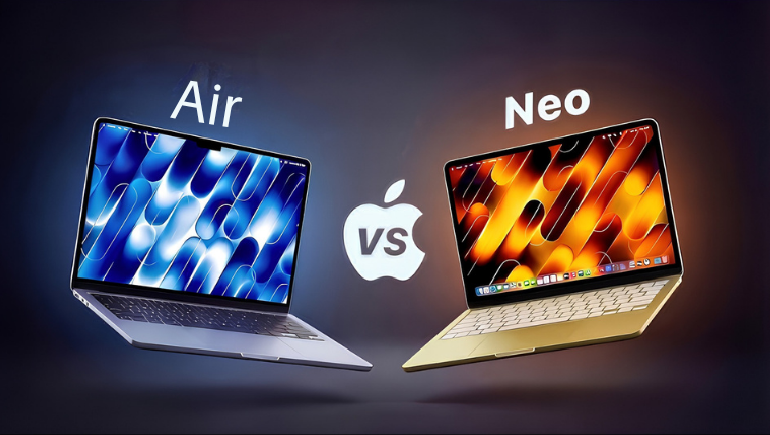
Apple’s 2026 laptop lineup introduces two distinct options for consumers: the all-new MacBook Neo and the latest M5 MacBook Air. While both devices deliver the familiar Apple experience, they target very different audiences. The MacBook Neo is designed as an affordable entry point into the Mac ecosystem, whereas the M5 MacBook Air continues to serve professionals, students, and creators seeking premium performance.
Both laptops feature Apple’s signature aluminum construction and portable form factor. The MacBook Neo includes a 13-inch Liquid Retina display with a resolution of 2408 × 1506 and 500 nits of brightness. It is available in colorful finishes such as Blush, Indigo, Citrus, and Silver. Apple positions the Neo as a stylish and budget-friendly option for everyday users.
The M5 MacBook Air offers a slightly larger 13.6-inch Liquid Retina display with a higher resolution of 2560 × 1664, support for one billion colors, True Tone technology, and a wider color gamut. These enhancements provide a more refined visual experience, particularly for creative work.
The biggest difference lies in processing power. The MacBook Neo is powered by Apple’s A18 Pro chip, the same architecture used in the iPhone lineup. Apple claims it delivers strong everyday performance for web browsing, office productivity, media consumption, and light creative tasks.
In contrast, the MacBook Air features Apple’s M5 processor, a full desktop-class chip with a 10-core CPU, advanced graphics options, hardware-accelerated ray tracing, and significantly higher memory bandwidth. The M5 is better suited for demanding workflows such as video editing, software development, multitasking, and AI-assisted applications.
The MacBook Neo starts with 8GB of unified memory and offers storage options of 256GB or 512GB. Memory is not configurable, which may limit long-term performance for power users.
The M5 MacBook Air starts with 16GB of unified memory and 512GB of SSD storage. Buyers can upgrade memory to 24GB or 32GB and configure storage up to 4TB, making it considerably more future-proof.
Apple rates the MacBook Neo for up to 16 hours of battery life. Connectivity is relatively basic, with two USB-C ports and a headphone jack. Some configurations omit premium features such as Touch ID and MagSafe charging.
The M5 MacBook Air offers up to 18 hours of video streaming, MagSafe charging, two Thunderbolt 4 ports, and broader support for professional accessories and external displays.
The MacBook Neo is an excellent choice for students, casual users, and budget-conscious buyers seeking an affordable MacBook experience. Meanwhile, the M5 MacBook Air remains the superior option for professionals and users who need stronger performance, expanded memory options, advanced connectivity, and greater longevity.
For buyers focused on value, the MacBook Neo is difficult to ignore. However, those looking for the best balance of power, versatility, and future readiness will find the M5 MacBook Air to be the more compelling investment.










Comments
There are no comments for this Article.