


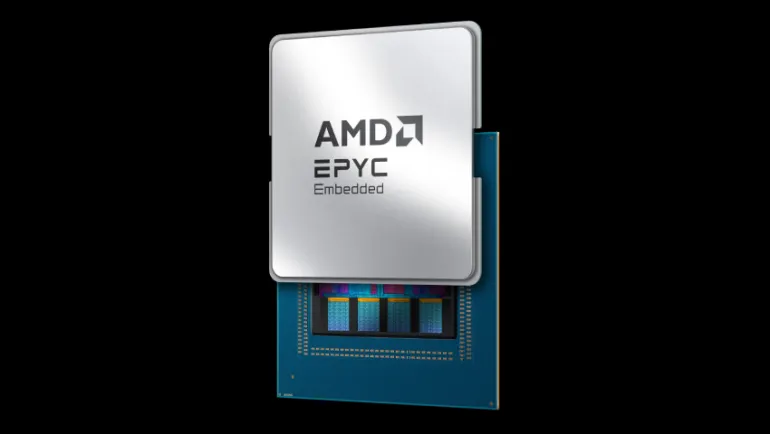
AMD EPYC Venice is the 6th Gen EPYC family, sold as EPYC 9006. It uses new Zen 6 and Zen 6c cores built on TSMC's 2 nm process. It offers up to 256 cores, 16 DDR5 memory channels, MRDIMM support, and PCIe 6.0.
Key Takeaways
- Zen 6 powers high-clock chips of up to 96 cores. Zen 6c powers dense chips of up to 256 cores.
- AMD claims about 27% higher instructions per clock (IPC) than Zen 5.
- Memory bandwidth rises to 1.6 TB/s per socket, up from 576 GB/s on Turin.
- PCIe 6.0 doubles per-lane bandwidth over PCIe 5.0.
- Prices run from $700 to $14,904 per chip in 1,000-unit quantities.
What Is AMD EPYC Venice?
Venice is AMD's newest data center processor line. It replaces the 5th Gen EPYC 9005 "Turin" family. AMD built it for cloud servers, virtualization, high-performance computing, and AI. The company puts special focus on agentic AI, where the CPU coordinates data, tools, and networking around the GPUs.
The lineup has 31 chips across two sockets, SP7 and SP8. That range lets buyers match a chip to a workload instead of overpaying.
What's New in AMD Zen 6 Architecture?
Zen 6 vs Zen 6c: What Is the Difference?
Both cores share the same architecture and instruction set. Zen 6 is the classic core, and it clocks higher. Zen 6c is the dense core, and it fits more cores into each chiplet. The table below shows how the two core types differ in size, cache, and best use.
| Feature | Zen 6 | Zen 6c |
|---|---|---|
| Cores per chiplet | Up to 12 | Up to 32 |
| L3 cache per chiplet | 48 MB | 128 MB |
| Max cores per socket | 96 | 256 |
| Best for | Per-core speed, low latency | Core density, throughput |
AMD also doubled L3 cache per core on the dense chip. Zen 6c now has 4 MB per core, up from 2 MB on Zen 5c.
How Much Faster Is Zen 6 Than Zen 5?
AMD claims an average IPC gain of about 27% over Zen 5 in enterprise, cloud, and AI workloads. Treat that number with care. Early independent Geekbench results at equal clock speed showed a smaller average gain of about 16.5%. Real gains will depend on your software.
Zen 6 also adds AI-focused instructions, including AVX512 FP16 and new vector math support, according to reports.
What Process Node Does Zen 6 Use?
Zen 6 uses TSMC's N2, a 2 nm class process. Smaller transistors help AMD pack more cores into each socket.
AMD EPYC Venice Specifications
AMD sells 31 Venice models, from 8 cores to 256 cores. The table below lists five key chips on the SP7 platform. It covers the flagship dense chip, a mid-range option, and the high-frequency models that boost to 5 GHz.
| Model | Cores / Threads | Base / Boost (GHz) | L3 Cache | TDP |
|---|---|---|---|---|
| EPYC 9996 | 256 / 512 | 2.55 / 4.1 | 1,024 MB | 600 W |
| EPYC 9966 | 192 / 384 | 2.9 / 4.0 | 768 MB | 600 W |
| EPYC 9756 | 128 / 256 | 3.15 / 4.0 | 512 MB | 500 W |
| EPYC 9686F | 96 / 192 | 3.4 / 5.0 | 384 MB | 500 W |
| EPYC 9586F | 64 / 128 | 3.75 / 5.0 | 384 MB | 500 W |
How many cores does AMD EPYC Venice support? It supports up to 256 cores and 512 threads per socket. A dual-socket server reaches 512 cores and 1,024 threads.
Memory and PCIe 6.0 Support
DDR5 RDIMM vs MRDIMM
Venice SP7 uses 16 memory channels, up from 12 on Turin. It supports standard DDR5 RDIMMs at 8,000 MT/s. It also supports MRDIMMs at 12,800 MT/s. MRDIMMs cost more, but they raise bandwidth for AI and data-heavy jobs. Without those extra channels, a 256-core chip would starve for memory.
PCIe 5.0 vs PCIe 6.0
PCIe 6.0 doubles the per-lane rate of PCIe 5.0. SP7 offers 128 lanes in one-socket systems and up to 160 in two-socket systems. Venice also supports CXL 3.1 for memory expansion. This matters most when you attach many GPUs, fast network cards, or NVMe drives.
EPYC SP7 vs SP8
Venice ships on two sockets. SP7 is the larger platform for top performance. SP8 is the smaller platform for compact servers and lower power budgets. The table below shows the main differences.
| Feature | SP7 | SP8 |
|---|---|---|
| Memory channels | 16 | 8 |
| Max power | 600 W | 400 W |
| Max cores | 256 | 128 |
| Target | AI hosts, dense cloud | Smaller deployments |
AMD put SP8 launch timing in the first half of 2027 when it announced Venice. Confirm current availability with your server vendor.
AMD EPYC Venice vs Turin: EPYC 9006 vs EPYC 9005
Many buyers run Turin today, so the upgrade question matters. Venice improves core count, memory, cache, and I/O at the same time. The table below puts the two generations side by side.
| Spec | Turin (EPYC 9005) | Venice (EPYC 9006) |
|---|---|---|
| Max cores | 192 | 256 |
| Memory channels | 12 | 16 |
| Memory bandwidth per socket | 576 GB/s | 1.6 TB/s |
| PCIe | 5.0 | 6.0 |
| L3 per core, dense chip | 2 MB | 4 MB |
AMD EPYC vs Intel Xeon and NVIDIA Vera
AMD ran its own tests, so wait for independent reviews. Against Intel's Xeon 6980P, AMD claims 3.4 times the result in the TPCx-AI data benchmark and 2.8 times in NGINX web serving. Against NVIDIA's Vera, AMD claims 2.2 times the SPECrate integer throughput with the 256-core chip. It also claims 1.2 times the per-core performance with a 96-core high-frequency chip.
Intel's Xeon 6 platforms still use PCIe 5.0. Intel's next generation, Xeon 7 "Diamond Rapids," is expected in 2027.
EPYC 9996 vs EPYC 9686F: Which Should You Choose?
Pick the EPYC 9996 if you need maximum throughput. It suits dense virtualization, containers, web hosting, and AI agent infrastructure.
Pick the EPYC 9686F if your software needs fast cores. It boosts to 5 GHz with fewer cores. That suits databases, per-core licensed software, and latency-sensitive services.
Chips with a "P" suffix work in single-socket servers only. They cost less than their standard versions. For example, the 128-core EPYC 9736P lists 6% below the EPYC 9736.
Which Workloads Fit EPYC Venice?
- AI and agent orchestration: high core counts and fast memory keep GPUs fed.
- Cloud and virtualization: dense Zen 6c chips raise compute density per rack.
- Databases and enterprise apps: large L3 cache and bandwidth help.
- Scientific computing and HPC: vector math and memory throughput matter most.
Price, Launch Date, and Availability
AMD announced Venice on July 22, 2026, at its Advancing AI event in San Francisco. List prices start at $700 for the 8-core EPYC 9016. The 256-core EPYC 9996 costs $14,904, or about $58 per core. The previous 192-core EPYC 9965 launched near $14,800. These are 1,000-unit prices, so your cost will differ.
One server builder lists SP7 systems for Q4 2026. AMD plans Venice-X, with up to 1,152 MB of stacked cache, for the second half of 2027.
Final Verdict
Venice raises core counts, memory bandwidth, and I/O in one step. The 256-core EPYC 9996 targets throughput. The 5 GHz models target per-core speed. Most performance claims come from AMD, so verify them with independent tests before you commit to a large order.
Frequently Asked Questions
What is AMD EPYC Venice?
AMD EPYC Venice is the 6th Gen EPYC server processor family. AMD sells it as the EPYC 9006 series. It uses Zen 6 and Zen 6c cores on TSMC's 2 nm process.
What is the difference between Zen 6 and Zen 6c?
Both use the same architecture and instruction set. Zen 6 clocks higher and scales to 96 cores per socket. Zen 6c packs more cores into each chiplet and scales to 256 cores per socket.
How many cores does AMD EPYC Venice have?
Venice offers from 8 to 256 cores per socket. The flagship EPYC 9996 has 256 cores and 512 threads. A two-socket server can reach 512 cores and 1,024 threads.
Does Venice support PCIe 6.0 and MRDIMM?
Yes to both. SP7 supports PCIe 6.0 with up to 128 lanes in one-socket systems. It also supports MRDIMMs at up to 12,800 MT/s, along with standard DDR5 RDIMMs.
How much does the EPYC 9996 cost?
AMD lists the EPYC 9996 at $14,904 in 1,000-unit quantities. The entry-level EPYC 9016 lists at $700. Your price will differ based on your vendor and order size.
When did AMD EPYC Venice launch?
AMD announced Venice on July 22, 2026, at its Advancing AI event. SP7 systems are expected from Q4 2026. AMD's original plan put SP8 in the first half of 2027.
Is Venice worth upgrading from Turin?
It is if you need more cores, memory bandwidth, or PCIe 6.0 devices. Turin's maximum is 192 cores with 12 memory channels and PCIe 5.0. Test your own workload before you buy.
Is EPYC Venice good for AI data centers?
AMD designed it for that job. The CPU orchestrates data, networking, and agent tasks around GPUs. High memory bandwidth and PCIe 6.0 help keep accelerators supplied. Most AMD performance claims come from its own tests, so confirm them with independent results.










Comments
There are no comments for this Article.